
Keysight PNA vs ENA vs R&S ZNB/ZNA: Choosing the Right VNA
When you compare vector network analyzers (VNAs), the family tier matters more than the brand. Keysight and Rohde & Schwarz both build an entry tier for RF passive components, a mid-range tier for general RF and multiport production, and a high-performance tier for microwave and millimeter-wave R&D. A Keysight ENA and an R&S ZNB are closer to each other than an ENA is to a Keysight PNA.
This guide maps the main families from both brands, including older models that are common on the used market, and organizes them by job: RF passive test, mid-range and multiport, microwave R&D, and modular, USB and handheld. If you are new to VNAs, start with our What Is a Vector Network Analyzer (VNA)? explainer.
All specifications below are summarized from manufacturer datasheets and are typical maximums for each family; individual units depend on installed options.
What changes as you move up a tier
Moving from an entry analyzer to a high-performance one usually brings four things: a higher maximum frequency, more dynamic range (the difference between the largest and smallest signal the analyzer can measure), more receivers and sources for complex measurements, and more measurement options for active devices. It also brings higher purchase, calibration and accessory costs. A filter manufacturer testing 2 GHz parts gains little from a 67 GHz PNA; a team characterizing a mmWave amplifier cannot do the job with an entry analyzer.
Keysight and R&S do not use the same tier labels, but their families line up in a similar way. The tiers used in this article (entry, mid-range, high-performance, plus modular and handheld) are our own grouping for comparison.
VNA families at a glance
The table below groups each family by tier. Use it to narrow the field by frequency and port count, then read the tier sections for the trade-offs.
| Brand | Family / model | Frequency range (max config) | Test ports | Tier | Typical use |
|---|---|---|---|---|---|
| Keysight | ENA E5061B | 5 Hz to 3 GHz (with LF-RF option) | 2 | Entry | RF passive components, LF impedance, power-supply loop gain |
| Keysight | ENA E5063A | 100 kHz to 18 GHz (by option) | 2 | Entry | Low-cost passive component test, PCB, cables |
| Keysight | ENA E5071C | 9 kHz to 8.5 GHz, or 300 kHz to 20 GHz (by option) | 2 or 4 | Mid-range | Production multiport, filters, cables |
| Keysight | ENA E5080A | 9 kHz to 9 GHz | 2 or 4 | Mid-range | RF R&D and production |
| Keysight | PNA E8363A | 10 MHz to 40 GHz | 2 | High (legacy) | Microwave R&D |
| Keysight | PNA N5222A / N5222B | 10 MHz to 26.5 GHz | 2 or 4 | High | Microwave R&D, active devices |
| Keysight | PNA N5224A | 10 MHz to 43.5 GHz | 2 or 4 | High | Microwave R&D |
| Keysight | PNA N5227B | 10 MHz to 67 GHz | 2 or 4 | High | mmWave R&D |
| Keysight | PNA-X (N524x family) | up to 67 GHz (with extension beyond) | 2 or 4 | High | Active devices, amplifiers, mixers, noise figure |
| Keysight | PXIe M9375A | 300 kHz to 26.5 GHz | 2 per module (multiport by adding modules) | Modular | Automated multiport test systems |
| Keysight | USB P5020A (Streamline) | Up to 20 GHz | 2 | Compact | Bench or automated test, PC-controlled |
| Keysight | FieldFox N9923A | 2 MHz to 6 GHz (by option) | 2 | Handheld | Field cable and antenna test |
| Keysight | FieldFox N9928A | 30 kHz to 26.5 GHz | 2 | Handheld | Field microwave test |
| R&S | ZNLE | 1 MHz to 18 GHz (by model) | 2 | Entry | Passive components, education |
| R&S | ZNL | 5 kHz to 20 GHz (by model) | 2 or 4 | Entry / mid | Bench VNA, optional spectrum analysis |
| R&S | ZNC3 | 9 kHz to 3 GHz | 2 | Entry | RF passive, production |
| R&S | ZND | 100 kHz to 4.5 GHz (8.5 GHz option) | 1 or 2 | Entry | Basic passive test |
| R&S | ZVL | 9 kHz to 13.6 GHz (by model) | 2 | Entry (legacy) | Passive test, optional spectrum analysis |
| R&S | ZNB (ZNB4/8/20/40) | 9 kHz to 8.5 GHz; 100 kHz to 20 or 40 GHz | 2 or 4 | Mid-range | RF R&D and production |
| R&S | ZNBT (ZNBT8/20) | 9 kHz to 8.5 GHz; 100 kHz to 20 GHz | up to 24 (ZNBT8), up to 16 (ZNBT20) | Mid-range multiport | Multiport production, multi-antenna |
| R&S | ZVA (e.g. ZVA67) | 10 MHz up to 67 GHz | 2 or 4 | High (legacy) | Microwave R&D, active devices |
| R&S | ZNA (ZNA26/43/50/67) | 10 MHz up to 67 GHz | 2 or 4 | High | Microwave R&D, active devices, mmWave |
| R&S | ZNH | 30 kHz to 26.5 GHz (by model) | 2 | Handheld | Field test |
| Ceyear | 3656 series | See product page | See product page | Entry / mid | General RF test |
| Ceyear | 3674 series | See product page | See product page | High | Microwave R&D |
Entry and RF passive tier: ENA E5061B/E5063A vs R&S ZNL/ZNLE/ZNC/ZND/ZVL
For filters, cables, antennas and other passive components up to a few GHz, an entry-tier VNA is usually enough. The main choices are the Keysight E5061B and E5063A, and the R&S ZNL, ZNLE, ZNC3, ZND and ZVL.
Points that separate them:
- Low-frequency coverage. The E5061B with its LF-RF option reaches down to 5 Hz and adds a gain-phase port, which makes it useful for power-supply loop-gain and impedance work in addition to RF. Most other entry models start at kHz or MHz.
- Frequency ceiling. The E5063A, ZNL and ZNLE extend into the microwave range on higher-frequency models, which helps if you test passive parts up to 14 to 20 GHz without needing PNA-class dynamic range.
- Combined functions. The ZNL and ZVL can include spectrum analysis as an option, useful in small labs that need both functions in one box.
- Direction. Some entry models (for example a unidirectional ZND) measure in one direction only, so a full two-port S-parameter measurement requires reversing the device. Check whether the unit is uni- or bidirectional.
Typical devices for this tier are RF filters, duplexers, antennas, cables, connectors and PCB traces at cellular, Wi-Fi and ISM frequencies. Dynamic range and trace noise in this tier are sufficient for most of these measurements at moderate IF bandwidths, but high-rejection filters may need a mid-range analyzer. Check port power range if you test sensitive active parts, since entry analyzers often have a narrower power sweep range.
Mid-range workhorses: E5071C/E5080A vs R&S ZNB/ZNBT
The mid-range tier is where most RF R&D and production test happens. The Keysight E5071C and E5080A and the R&S ZNB family (ZNB8, ZNB20, ZNB40) cover RF to microwave frequencies with two or four ports, good measurement speed and fixture-simulation and time-domain options.
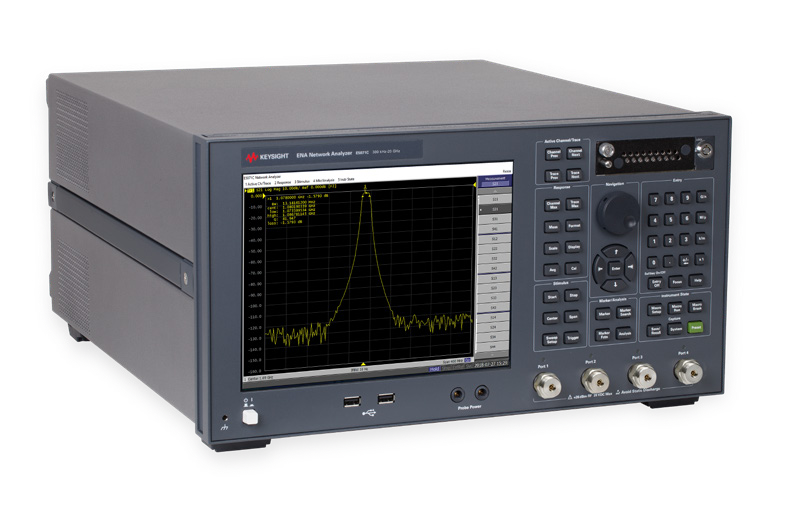
Keysight E5071C: representative image from the wnot.cn product page (the site labels it as not a photograph of the exact unit).
- E5071C. A long-running production VNA, available in 2-port and 4-port versions. Its option codes define port count and frequency range (for example, 2-port and 4-port 8.5 GHz versions), so read the option list carefully. Its large installed base makes it common on the used market.
- E5080A. The newer ENA platform, with a different user interface shared with the PNA family and up to 9 GHz. It suits labs that want a modern interface at mid-range cost.
- ZNB. R&S’s mid-range family, with 2-port and 4-port versions and models up to 40 GHz. In positioning it competes mainly with the ENA and E5080 tier.
- ZNBT for multiport. The ZNBT8 and ZNBT20 are designed for true multiport measurements without external switch matrices, with up to 24 ports on the ZNBT8 and up to 16 on the ZNBT20. For multi-antenna, front-end module and connector testing they avoid the extra calibration and loss of switch matrices.

Rohde & Schwarz ZNBT8: representative image from the wnot.cn product page (the site labels it as not a photograph of the exact unit).
E5071C vs E5080A
Both are Keysight ENA analyzers in the mid-range tier, and both are common in used listings. The practical differences:
- Frequency. The E5071C reaches 8.5 GHz on its standard RF versions and up to 20 GHz on its higher-frequency versions; the E5080A reaches 9 GHz.
- User interface and software. The E5080A uses the same software platform and touch interface as current PNA models, so measurement setups and automation code transfer more easily between them. The E5071C has its own interface and SCPI command set, which many existing production test programs are written for.
- Installed base. The E5071C has been on the market for many years, so used units, fixtures and test code are widely available. The E5080A is newer, which can mean longer remaining support.
If you are extending an existing E5071C production line, staying with the E5071C keeps your test code unchanged. For a new bench, the E5080A or its successor is often the better long-term choice.
Microwave R&D: PNA (N5222B, N5224A, N5227B) vs R&S ZVA/ZNA
For microwave and millimeter-wave R&D and active-device characterization, the high-performance tier offers wider dynamic range, more receivers and more source flexibility. The Keysight PNA family covers this tier on the Keysight side, and the R&S ZVA (older) and ZNA (current) on the R&S side.
- Keysight PNA. Legacy and current models include the E8363A (40 GHz), N5222A and N5222B (26.5 GHz), N5224A (43.5 GHz) and N5227B (67 GHz). The PNA-X adds a second internal source, internal combiner and options for noise figure and nonlinear measurements, which matters for amplifiers and mixers.
- R&S ZVA and ZNA. The ZVA67 is an established 67 GHz platform that is common used. The ZNA (including the ZNA67) is the current high-end family, with up to four internal sources on four-port models and options for mixers, pulsed and spectrum measurements. In positioning, the ZNA is generally compared with the PNA and PNA-X.
- Millimeter-wave extension. Beyond 67 GHz, both brands use frequency extenders. Keysight’s N5251A is a complete millimeter-wave network analyzer system built on a PNA, reaching 110 GHz or more.
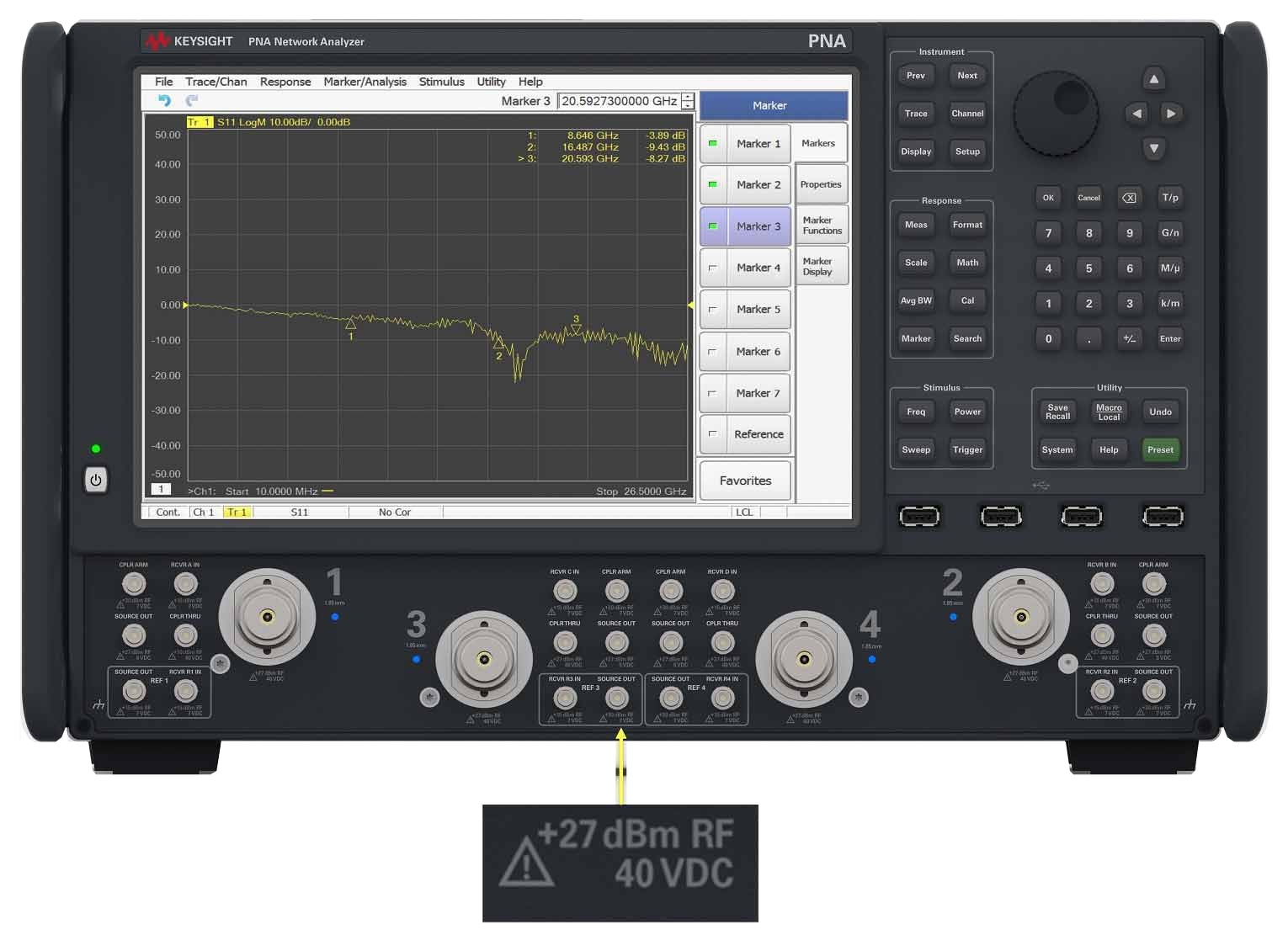
Keysight N5227B: representative image from the wnot.cn product page (the site labels it as not a photograph of the exact unit).
Active-device options to check include pulse measurements, frequency offset (for mixers and converters), source power calibration, and internal bias tees.
Connector and calibration costs at high frequency
At 26.5 GHz and above, the analyzer is only part of the cost. Analyzers in this tier use 3.5 mm, 2.4 mm or 1.85 mm test ports depending on frequency, and each connector family needs its own test-port cables, adapters, torque wrenches and calibration kit or ECal module. A 67 GHz system with 1.85 mm accessories can cost a substantial fraction of the analyzer itself. When comparing a used PNA with a used ZVA or ZNA, include the accessories you will need, and check whether the seller includes any.
Modular, USB and handheld VNAs
If you need a VNA in a test system, on a production line or in the field, a modular, USB or handheld VNA can be a better fit than a benchtop unit.
- PXIe: the Keysight M9375A is a PXIe VNA module. Several modules in one chassis can act as a multiport VNA. You need a PXIe chassis, controller and Keysight software.
- USB: the Keysight P5020A is a compact 2-port VNA controlled from a PC over USB, with the same measurement software as larger Keysight VNAs.
- Handheld: the Keysight FieldFox N9923A and N9928A, and the R&S ZNH, are battery-powered analyzers for cable, antenna and site measurements. They trade some dynamic range and speed for portability.
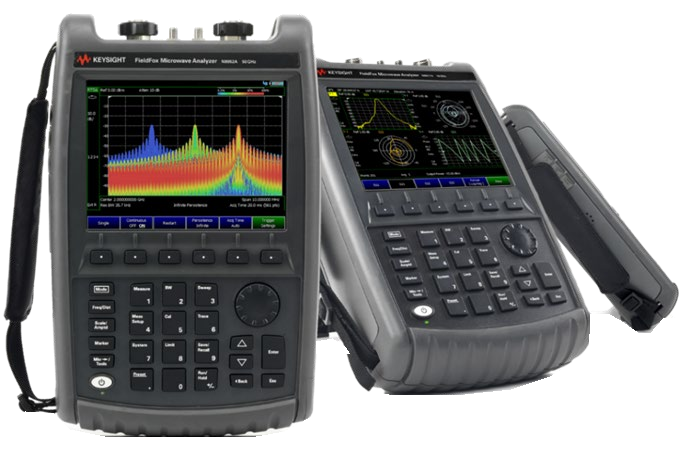
Keysight N9928A FieldFox: representative image from the wnot.cn product page (the site labels it as not a photograph of the exact unit).
Modular and USB analyzers make sense when the analyzer is part of an automated system: the controlling PC already exists, rack space is limited, or you want many ports in one chassis. They need a host computer and software installation, and they have no front panel for quick manual checks. Handheld analyzers are built for field use, with battery operation, rugged cases and cable-and-antenna modes, but they are rarely the best choice for precision lab work.
Which one should you buy used?
The best used value depends on whether the model is still supported, whether parts and calibration are available, and how old its operating system is. Choose a model that is still supported if the analyzer must stay in service for many years.
| Need | Value picks (from stock) | Why | Watch for |
|---|---|---|---|
| RF passive test to 3 GHz | E5061B, ZNC3 | Wide availability, simple configuration | LF option on E5061B; uni/bidirectional on entry R&S units |
| Passive test into microwave | E5063A, ZNLE | Lower cost per GHz | Frequency option installed |
| Production, 4-port to 8.5 GHz | E5071C, ZNB8 | Large installed base, common automation code | Port/frequency option code; OS age |
| True multiport | ZNBT8, ZNBT20 | No external switch matrix needed | Installed port count |
| Microwave R&D to 26.5 GHz | N5222B, ZNB20 | Current or recent platforms | Options for active devices |
| mmWave R&D to 67 GHz | N5227B, ZVA67, ZNA67 | Full 67 GHz coverage | 1.85 mm connector condition; cal kit cost |
Older models such as the E8363A and N5222A can be cost-effective for labs that work offline, but check the operating system version, firmware support and whether the manufacturer still calibrates and repairs the model. For the inspection steps, see our upcoming guide, Buying a Used Vector Network Analyzer: 10 Checks Before You Pay.
Three points apply to any used VNA purchase, whatever the brand:
- Operating system age. Older benchtop VNAs run embedded Windows versions that may no longer receive security updates. If the analyzer must connect to your company network, check your IT policy first.
- Options are licenses. Time-domain, frequency offset, pulse and other options are tied to the serial number. A lower-priced unit missing a key option can cost more in the end.
- Port condition. Test-port connectors wear with use. Inspect them before purchase.
Software, calibration and ecosystem
Each brand has its own ecosystem of calibration hardware and software, so factor in cal kits, ECal modules and automation code, not just the analyzer.
- SCPI and automation. Both brands support SCPI over LAN and GPIB, but command sets differ between brands and sometimes between families. Moving from an E5071C to an E5080A, or from Keysight to R&S, usually means updating test code.
- Calibration kits. Mechanical calibration kits can be used across brands if the analyzer has the kit’s definition (standards data) loaded. Many analyzers include definitions for common kits.
- Electronic calibration (ECal). Keysight ECal modules and R&S calibration units are designed for their own analyzers. Cross-brand use is generally not supported directly.
See our Calibration Accessories category for ECal modules and mechanical kits.
Measurement data is more portable than automation code. Both brands export Touchstone files (.s1p, .s2p, .s4p and so on), so simulation tools and data analysis scripts generally work with either. If you run a mixed-brand lab, keep your post-processing based on Touchstone files and isolate the instrument-specific SCPI commands in one layer of your test software.
Decision flowchart (text version)
- Frequency. Up to 3 GHz: entry tier. Up to 8.5 or 9 GHz: mid-range. Up to 26.5 to 67 GHz: PNA, ZNB20/40, ZVA or ZNA. Above 67 GHz: extender-based system such as the N5251A.
- Ports. Two ports for most components. Four ports for differential and balanced devices. More than four: ZNBT, switch matrix, or modular PXIe.
- Passive or active. Passive devices: entry or mid-range. Amplifiers, mixers, converters: PNA, PNA-X, ZVA or ZNA with active-device options.
- Environment. Bench, rack system (PXIe/USB) or field (FieldFox, ZNH).
- Budget and support. Choose new or used, and check support status and OS age for used models.
Browse all Network Analyzers, or see our Wireless Communications & 5G solution page for related test setups.
FAQ
What is the difference between Keysight PNA and ENA?
The ENA is Keysight’s mid-range and entry VNA line for RF and lower microwave frequencies, used widely in production. The PNA is the high-performance line, reaching higher frequencies with wider dynamic range and options for active devices such as amplifiers and mixers. The PNA-X extends the PNA with additional sources and measurement functions.
Is the R&S ZNB equivalent to the Keysight ENA or the PNA?
The ZNB is generally positioned against Keysight’s mid-range tier, the E5071C and E5080 ENA analyzers, though higher-frequency ZNB models overlap with lower PNA models in frequency. For high-end microwave and active-device work, the R&S ZNA and ZVA are the more direct counterparts to the PNA and PNA-X.
Is the E5071C still a good buy used?
The E5071C is a widely used production workhorse, and its large installed base makes used units and test code easy to find. Before buying, check its operating system version, firmware and Keysight’s current support and calibration status for the model, and confirm that its option code gives the ports and frequency range you need.
Which VNA is best for multiport testing?
It depends on port count and frequency. For four ports, the E5071C, E5080A, ZNB or PNA 4-port versions work well. For more ports without an external switch matrix, the R&S ZNBT supports up to 24 ports. Modular PXIe analyzers such as the M9375A can also build multiport systems.
Can I use a Keysight ECal with an R&S VNA?
Generally no. Electronic calibration modules are designed for their own manufacturer’s analyzers and control software, so a Keysight ECal is not normally used directly with an R&S analyzer, or the reverse. Mechanical calibration kits are more portable across brands if the analyzer has the kit definition loaded.
What VNA do I need for mmWave?
Up to 67 GHz, a 67 GHz-capable PNA, ZNA or ZVA covers most work. Above that, you need frequency extenders or a complete system such as the Keysight N5251A. Plan for 1.85 mm or 1.0 mm connectors, matching calibration kits and careful connector care, which add significantly to system cost.
Choosing between families? Tell us frequency, ports and DUT type. We’ll shortlist Keysight and R&S options from stock with prices side by side.
Request a quote · Test Equipment Sales · Repair Services
Trading in an older VNA? Request a valuation.