
Keysight 8163, 8164 and 8166 Lightwave Mainframes: Which One to Buy Used
Keysight (formerly Agilent) built one modular platform for most of its benchtop optical power meters, laser sources, attenuators, switches and return-loss modules. The modules plug into one of three mainframes: the 8163 Lightwave Multimeter, the 8164 Lightwave Measurement System and the 8166 Lightwave Multichannel System. Each came in A and B generations.
All three run largely the same modules, so the right mainframe depends on how many slots you need and whether you will use a high-performance back-loadable tunable laser. This guide compares the mainframes, explains module compatibility in plain language, and lists what to check when buying used. Specifications and compatibility statements are summarized from Keysight datasheet 5988-3924 and Keysight’s module configuration guide.
On the used market, mainframes and modules are often sold separately. That makes the platform flexible: you can start with a mainframe and two power sensors, then add a source, attenuator or switch later. It also means a buyer has to check compatibility, firmware and accessories that a factory-configured system would have included.
The three mainframes at a glance
The 8163 has two module slots, the 8164 has one extended slot for a back-loadable tunable laser plus four module slots, and the 8166 has seventeen module slots.
| 8163A / 8163B | 8164A / 8164B | 8166A / 8166B | |
|---|---|---|---|
| Имя | Lightwave Multimeter | Lightwave Measurement System | Lightwave Multichannel System |
| Compact module slots | 2 (slots 1–2) | 4 (slots 1–4) | 17 (slots 1–17) |
| Back-loadable TLS slot | No | Yes, slot 0 | No |
| Form factor | Compact, portable bench unit | Benchtop with large display | Benchtop / rack, high channel count |
| Typical use | Power and loss checks, small setups | Swept-wavelength component test with high-end TLS | Multichannel power or attenuator systems |
| Remote interfaces | GPIB, RS-232 | GPIB, RS-232, LAN on B version | GPIB, RS-232 |
| On wnot.cn | 8163A, 8163B | 8164A (no 8164B currently in stock) | 8166A, 8166B |
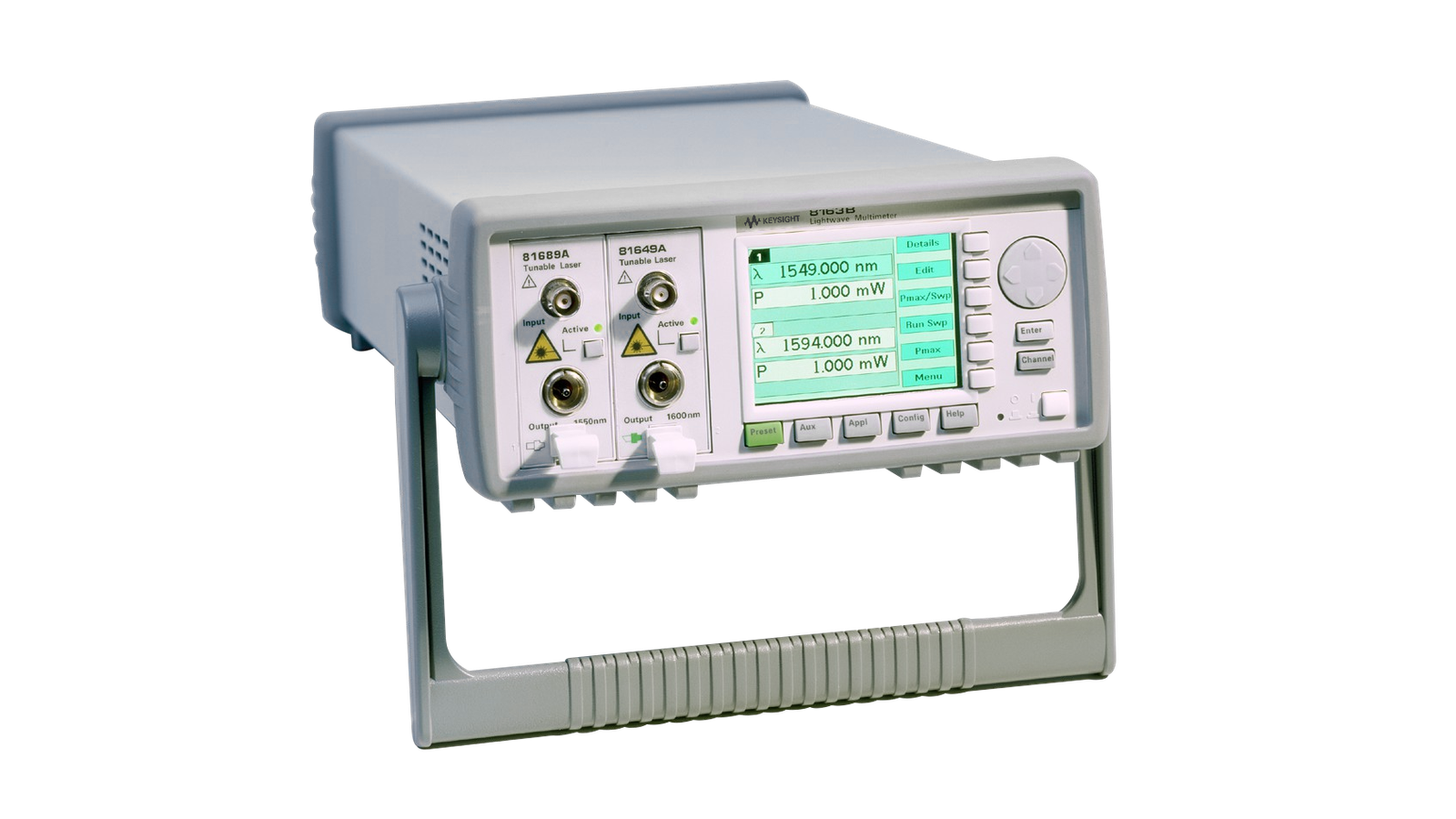
Keysight 8163B: representative image from the Страница продукта на сайте wnot.cn (на сайте указано, что это не фотография именно этой модели).
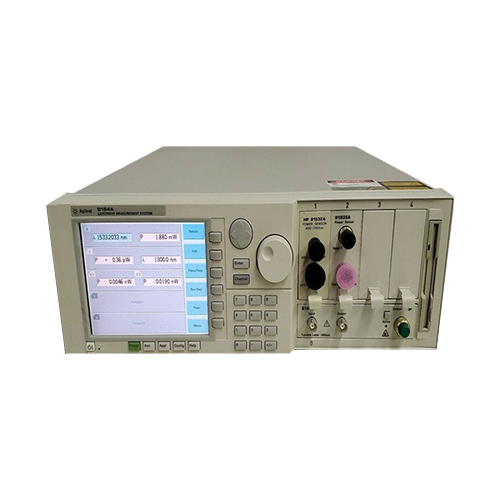
Agilent 8164A: representative image from the Страница продукта на сайте wnot.cn (на сайте указано, что это не фотография именно этой модели).
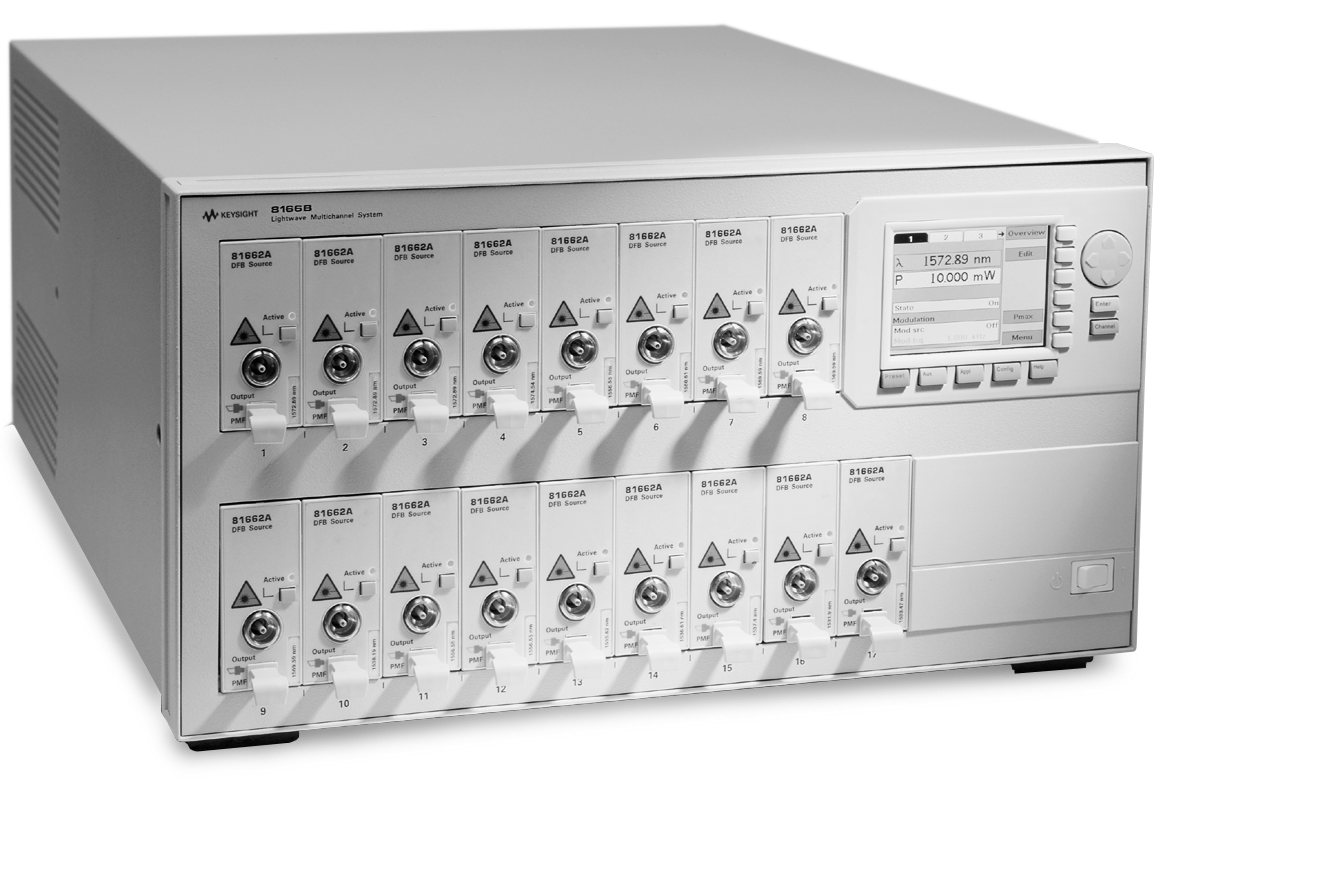
Keysight 8166B: representative image from the Страница продукта на сайте wnot.cn (на сайте указано, что это не фотография именно этой модели).
Module compatibility, explained
Most compact modules work in all three mainframes. The main exception is the back-loadable tunable laser, which needs the 8164’s slot 0. Some legacy modules have narrower support.
Compact modules work across all three
Compact (front-loadable) modules, such as optical power sensors, compact tunable lasers, return-loss modules, attenuators and switches, fit the standard slots of the 8163, 8164 and 8166. A module bought for one mainframe can normally be moved to another.
Back-loadable tunable lasers need 8164 slot 0
High-performance back-loadable tunable laser sources (TLS), including the 81600B family and back-loadable 816xxA/B lasers such as the 81640A and 81680A, install from the rear into slot 0 of the 8164 only. The 8163 and 8166 have no slot 0. If you plan to use a back-loadable TLS, you need an 8164.
Back-loadable lasers are generally the higher-performance options, with wider tuning ranges, higher output power or lower source spontaneous emission, depending on the model. Compact tunable lasers trade some of this performance for the ability to fit in any standard slot, and several can be installed in one mainframe for multi-wavelength setups.
Legacy 815xx modules
Older 815xx-series modules from the earlier 8153A platform are supported in the 8163 and 8164. In the 8166, only some of them are supported, such as the 8156x attenuators and 8159x switches.
A vs B mainframes
Keysight states that the A and B mainframes are functionally compatible with the modules. The B versions are later revisions with updated hardware and firmware. Firmware matters: newer modules may need a minimum mainframe firmware version, so check the installed firmware against the module’s requirements.
Which mainframe for which job
Choose by slot count and laser type:
- Portable power and loss checks: 8163. Two slots are enough for a power sensor and a source, or two power sensors, for insertion loss and simple power monitoring. It is the smallest and usually the least expensive mainframe.
- Swept-wavelength component test: 8164. With a back-loadable TLS in slot 0 and up to four power sensors, it supports wavelength-swept insertion loss and spectral measurements of passive components such as filters, gratings and couplers.
- High-port-count production: 8166. With 17 slots, it suits systems with many power sensor or attenuator channels, for example multi-channel monitoring or production test. Because the 8166B is obsolete, also consider the standalone N77xx series (see below).
Two practical points affect the choice. First, count the slots you need now and in the next few years; moving from an 8163 to an 8164 later means buying a second mainframe. Second, check your control software. Many existing automated systems were written for a specific mainframe and slot layout, and changing mainframes may require updating slot numbers and driver settings in the test code.
Matching modules to tasks
Use this list to match modules in our stock to common measurements.
Power measurement
- 81634B low-PDL optical power sensor
- 81635A dual optical power sensor (two channels in one slot)
- 81636B fast optical power sensor, for swept-wavelength measurements
- 81624B optical power head, used with the 81618A or 81619A interface module (single or dual head)
Sources
- 81640A tunable laser source
- 81680A tunable laser source
- 81940A and 81989A compact tunable laser sources
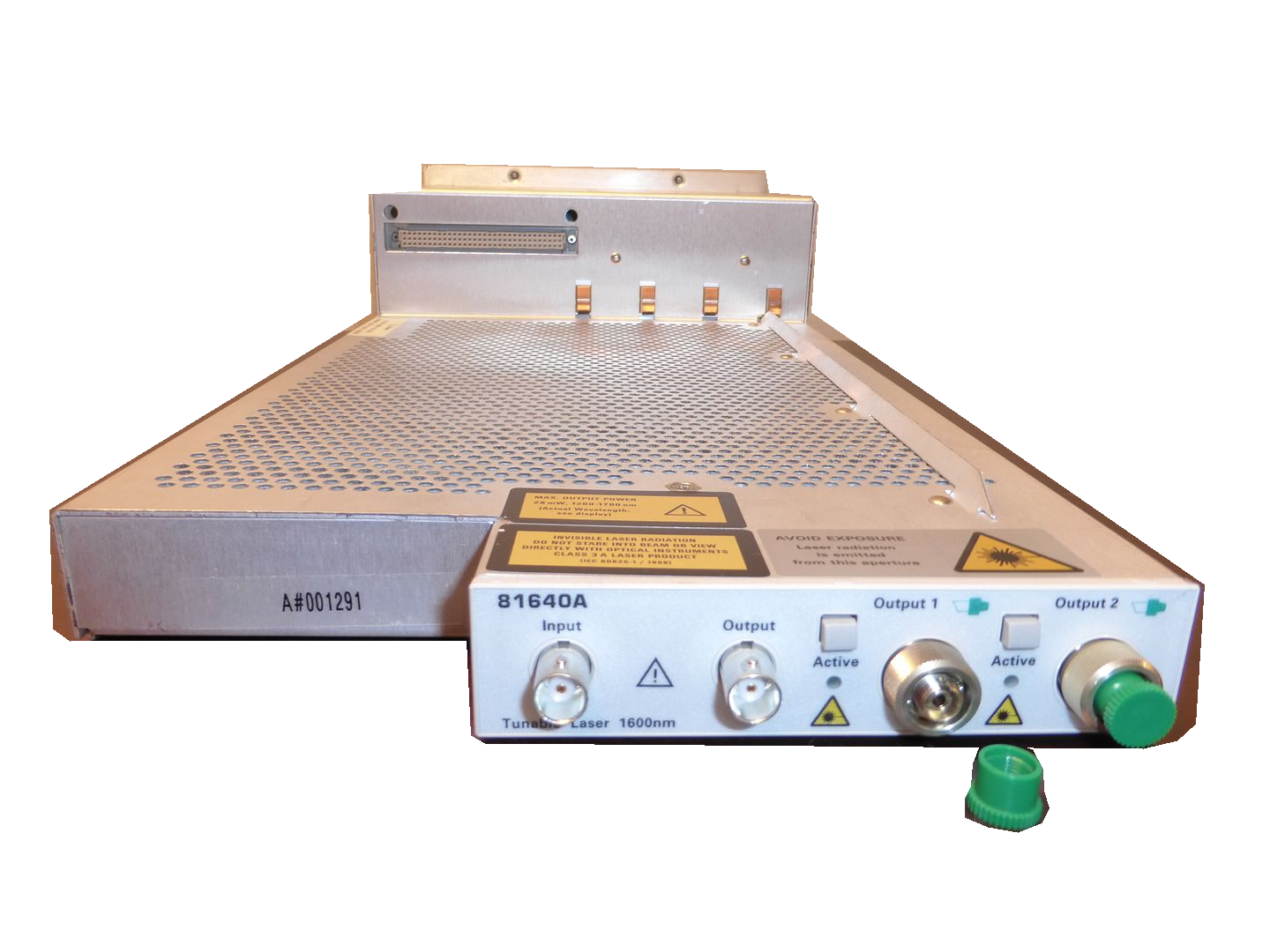
Keysight 81640A: representative image from the Страница продукта на сайте wnot.cn (на сайте указано, что это не фотография именно этой модели).
Return loss
- 81610A optical return loss module
Attenuation
- 81576A variable optical attenuator module
Switching
- 81595B optical switch module
See also Оптические измерители мощности and Оптические источники.
Typical module combinations
- Insertion loss of a passive component at fixed wavelengths: a source (or compact TLS) plus two power sensors, one for reference and one for the output. Fits an 8163 or 8164.
- Swept-wavelength insertion loss and spectral response: a back-loadable TLS in 8164 slot 0 plus fast power sensors such as the 81636B. The mainframe’s built-in swept-wavelength application, or Keysight’s software, logs power against wavelength.
- Return loss: an 81610A return-loss module with a suitable source.
- Multi-channel power monitoring: several dual power sensors (81635A) in an 8166, or a standalone N7745C.
- Automated multi-port routing: an 81595B switch module combined with power sensors or a source.
Used buyer’s checklist
Before buying a used lightwave mainframe or module, check the following:
- Mainframe generation and firmware. Record A or B, and the firmware version; compare with the firmware your modules need.
- Slot-0 filler. An 8164 without a back-loadable laser should have the 81645A filler module in slot 0 for correct airflow and protection.
- Module self-test. Ask for a screenshot showing every module recognized and passing self-test.
- Power sensor zeroing. Ask whether power sensors zero correctly with the input covered. A sensor that will not zero, or that drifts, may need service.
- Connector interfaces and adapters. Many power sensors and sources use exchangeable connector interfaces (the 81000xI series, for example FC/PC or SC types). Check which are included and whether they match your fiber connectors.
- Laser safety key and interlock. Laser sources need a working safety key or interlock to enable output. Make sure it is included.
- Remote control. Confirm GPIB or LAN works, and check that your software supports the model through the Keysight 816x plug&play or IVI drivers.
- Calibration certificates for power sensors. Ask for calibration data at the wavelengths you use.
Repairability of the 8166B. As an obsolete product, factory repair and spare parts may be limited. Ask whether the seller can repair it. See our Ремонтные услуги.
Wavelength range of each module. Power sensors, sources and attenuators are specified over defined wavelength ranges. Check that each module covers your wavelengths, for example the O-band, C-band or L-band.
- Fiber type. Check whether each module is for single-mode or multimode fiber, and whether the input is a free-space detector or a fiber connector.
On arrival, power on the mainframe with all modules installed, confirm each module is recognized in its slot, zero the power sensors, and measure a known source through a known patch cord. Record the results with serial numbers and the date, and report any problem promptly. There is no fixed return window: if an inspection confirms a product-quality issue, TXRX will repair or replace the unit. Returns for reasons other than product quality are not accepted.
At TXRX Instrument, every instrument we sell is inspected and functionally verified by our engineers (per our Продажа испытательного оборудования page). TXRX pre-owned equipment comes with a 6-month warranty. For pre-owned units, a calibration certificate or test report is available (as stated in your quotation). New equipment carries the manufacturer’s standard warranty as published by each brand and includes a factory calibration certificate.
Modern alternatives: the N77xx series
Keysight’s N77xx series offers standalone, LAN- and USB-controlled instruments for many of the same jobs, without a mainframe. Examples on wnot.cn:
- N7776C and N7778C tunable laser sources
- N7745C multiport optical power meter
- N7764A four-channel variable optical attenuator
These suit new automated systems and high channel counts. The 816x platform remains cost-effective when you already own modules or need a flexible mix of functions. The trade-off is flexibility: an N77xx instrument does one job, while a mainframe can be reconfigured by swapping modules. If you are building a new production system with many identical channels, standalone instruments are often simpler to integrate and support. If you are equipping a development lab that changes setups often, a mainframe with a mix of modules can be the more economical choice. Browse all Оптические и коммуникационные испытания equipment.
Часто задаваемые вопросы
What is the difference between the 8163B and 8164B?
The 8163B has two compact module slots in a small, portable mainframe. The 8164B has four compact slots plus slot 0, an extended rear-loading slot for high-performance back-loadable tunable laser sources, and a larger display. Choose the 8164B if you need a back-loadable tunable laser or more than two modules.
Can I use 8163A modules in an 8164B?
Yes. According to Keysight, the B-version mainframes support the 8153A Series 1 modules and 8163A/B-series modules, and compact modules generally move between the 8163, 8164 and 8166. Check the minimum firmware version required by newer modules before mixing generations.
Which mainframe do I need for a 81600B tunable laser?
You need an 8164A or 8164B. The 81600B family are back-loadable tunable lasers that install into slot 0, which only the 8164 has. The 8163 and 8166 cannot hold a back-loadable laser; they accept compact tunable laser modules instead.
Is the 8166B still supported?
Keysight lists the 8166B as obsolete. In practice, this means factory repair, calibration and spare parts may be limited or unavailable over time. If you buy one used, plan for third-party repair and spares, or consider an N77xx-based system for long-term support.
Are A-version mainframes worth buying?
They can be, at a lower price. Keysight states the A and B mainframes are functionally compatible with modules, but A versions are older, may run older firmware and may lack interfaces such as LAN. Check firmware and interfaces against your modules and automation needs before buying.
Building or extending a lightwave system? Send us your module list. We’ll check mainframe compatibility and quote a working system, or value the lightwave modules you no longer use.